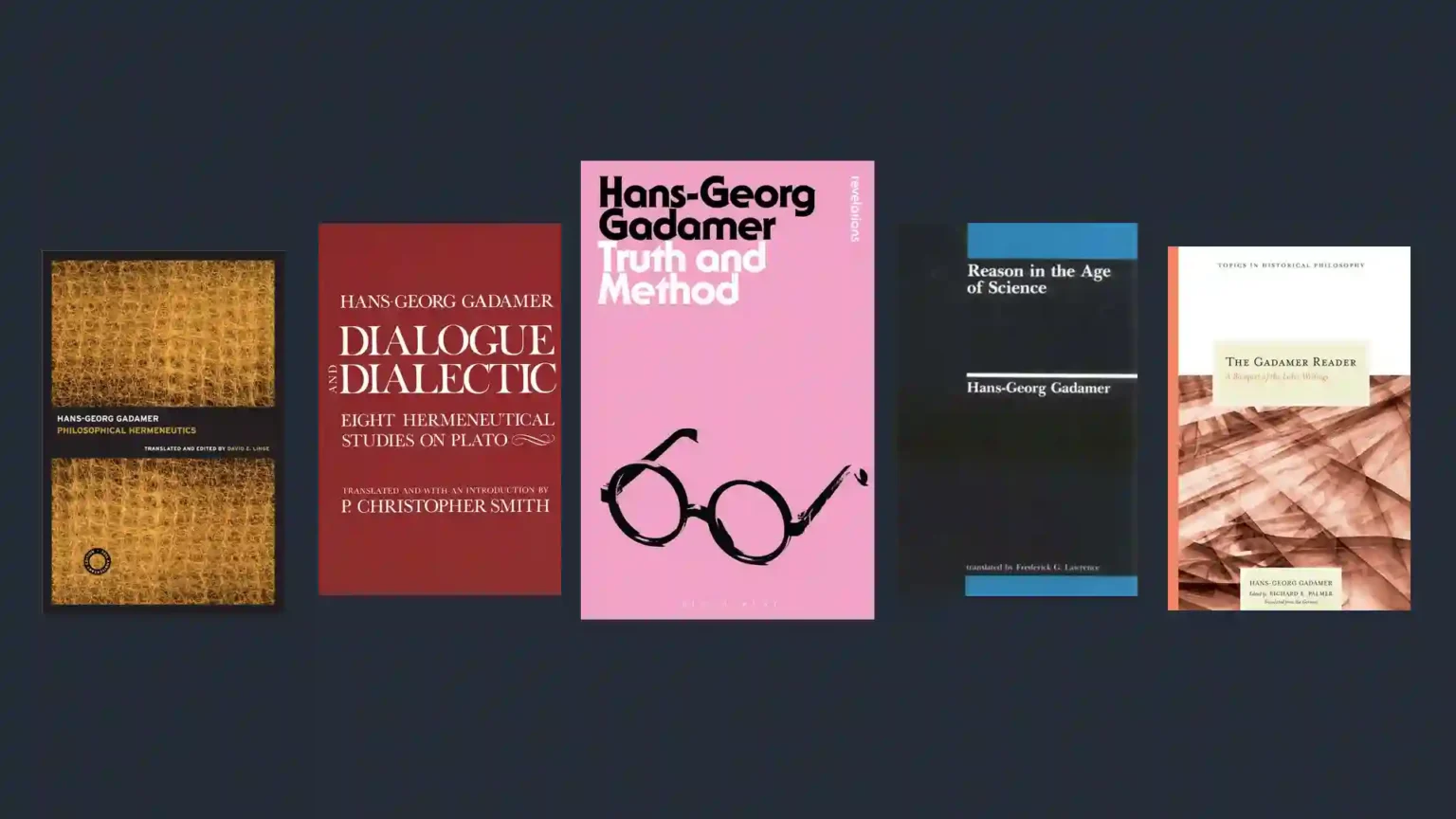
Five books on Gadamer’s hermeneutics open different routes into tradition, interpretation, language, historical understanding, and the limits of method.
The shortest defensible answer is that Hans-Georg Gadamer’s hermeneutics begins with Truth and Method but does not end there. The book gives the architecture; the other four titles below show what that architecture does when it meets phenomenology, Plato, practical reason, later self-interpretation, and criticism. Readers who approach Gadamer only through the phrase “fusion of horizons” often miss the argumentative pressure behind it: the question is not how to blend two opinions, but how historically situated understanding can make claims to truth without pretending to stand outside history.
1. Truth and Method — The Center of Gadamer’s Hermeneutics
Start with Truth and Method. Bloomsbury’s current edition record shows the book’s three-part movement: from the truth of art, through understanding in the human sciences, to the ontological role of language. That sequence matters. Gadamer is not merely proposing a technique for interpreting texts. He is arguing that understanding is an event shaped by tradition, language, application, and what he calls historically effected consciousness. The apparent opposition in the title is therefore productive: method has value, but method cannot exhaust the truth experienced in art, history, dialogue, and interpretation.
2. Philosophical Hermeneutics — the arguments in smaller units
Next read Philosophical Hermeneutics. The University of California Press collection gathers essays on the universality of the hermeneutical problem, language, self-understanding, aesthetics, phenomenology, and Heidegger. The advantage is diagnostic. A reader can isolate one concept at a time and ask whether Gadamer’s broader claims survive outside the immense architecture of Truth and Method. This is also where the comparison with Husserl and Heidegger becomes easier to track. BookInLight’s hermeneutics reading guide places Gadamer after Schleiermacher, Dilthey, and Heidegger for precisely this reason: his project only becomes clear when method has already been turned into an ontological problem.
3. Dialogue and Dialectic — a test case in reading Plato
Then move to Dialogue and Dialectic. These essays on Plato are not a side interest. They show Gadamer practicing what his theory says: interpretation is dialogical, historical, and responsive to a question that the text can still put to the present. The volume is valuable because it creates a counterexample to the lazy caricature that philosophical hermeneutics simply licenses the reader’s perspective. Gadamer’s Plato readings are constrained by text, argument, language, and the history of interpretation even as they refuse the fantasy of a view from nowhere.
4. Reason in the Age of Science — hermeneutics as practical reason
The fourth book, Reason in the Age of Science, changes the scale. Here hermeneutics enters questions of science, technology, social policy, and practical rationality. The MIT Press description is especially helpful because it makes explicit something frequently missed in introductory summaries: Gadamer did not intend hermeneutics to be politically and practically inert. These essays force a comparison with critical theory and with the demand that understanding be able to distinguish inherited authority from justified authority. The test is simple: can dialogue do more than reconcile us to tradition? Gadamer’s answer is more demanding than either his defenders or his critics sometimes admit.
Edition check: MIT Press lists the English-language hardcover of Reason in the Age of Science, translated by Frederick G. Lawrence, as published in March 1982, and the paperback edition in September 1983. These are edition dates, not competing dates for Gadamer’s original essays. Sources: MIT Press edition record.
5. The Gadamer Reader — the late work and the self-corrections
Finish with The Gadamer Reader. Its essays range across language, art, practical philosophy, Plato, Hegel, Heidegger, and Derrida. Because many pieces come from Gadamer’s later decades, the volume lets readers see what he chose to restate, sharpen, or defend after the international reception of his major work. It is also a useful antidote to treating Gadamer as a single-book philosopher. For readers who want a contemporary scholarly check on this route, Robert J. Dostal’s Gadamer’s Hermeneutics: Between Phenomenology and Dialectic provides a recent critical reconstruction of the project.
The order is deliberate: architecture, clarification, application, practical testing, retrospective restatement. It also reveals a persistent tension. Gadamer wants understanding to acknowledge historical belonging without collapsing into relativism; he wants tradition to be productive without becoming automatically authoritative; he wants dialogue to transform both sides without pretending that power, error, and exclusion disappear. Those tensions are not bugs to be removed before reading. They are the reasons to read the five books together.
A useful countercheck is to ask what each book makes difficult. Truth and Method makes it difficult to imagine interpretation as the recovery of a meaning untouched by the interpreter’s history. Philosophical Hermeneutics makes it difficult to reduce that claim to a slogan because the essays repeatedly qualify the relation among language, self-understanding, phenomenology, and tradition. Dialogue and Dialectic makes it difficult to accuse Gadamer of ignoring textual discipline, because his Plato readings are arguments rather than celebrations of openness. Reason in the Age of Science makes it difficult to say hermeneutics has no practical stakes. The later reader makes it difficult to pretend the philosophy stopped developing after 1960.
The central disagreement to carry through all five books concerns authority. Does historically effected understanding give tradition too much power over critique, or does critique itself always inherit a language and set of questions it cannot simply step outside? Gadamer’s exchanges with Habermas and his later reception matter because they keep this question open. Read the sequence comparatively, not devotionally. The best introduction to Gadamer is one that shows both why his account of understanding is compelling and why readers worried about ideology, exclusion, or asymmetrical dialogue refuse to let conversation be the final word.
Cover artwork: credits and source records
- Truth and Method — Bloomsbury (source record)
- Philosophical Hermeneutics — University of California Press (source record)
- Dialogue and Dialectic — Yale University Press (source record)
- Reason in the Age of Science — MIT Press (source record)
- The Gadamer Reader — Northwestern University Press (source record)