To find Cézanne’s Doubt in a reliable collection, distinguish Merleau-Ponty’s original essay from its later English-language anthology contexts.
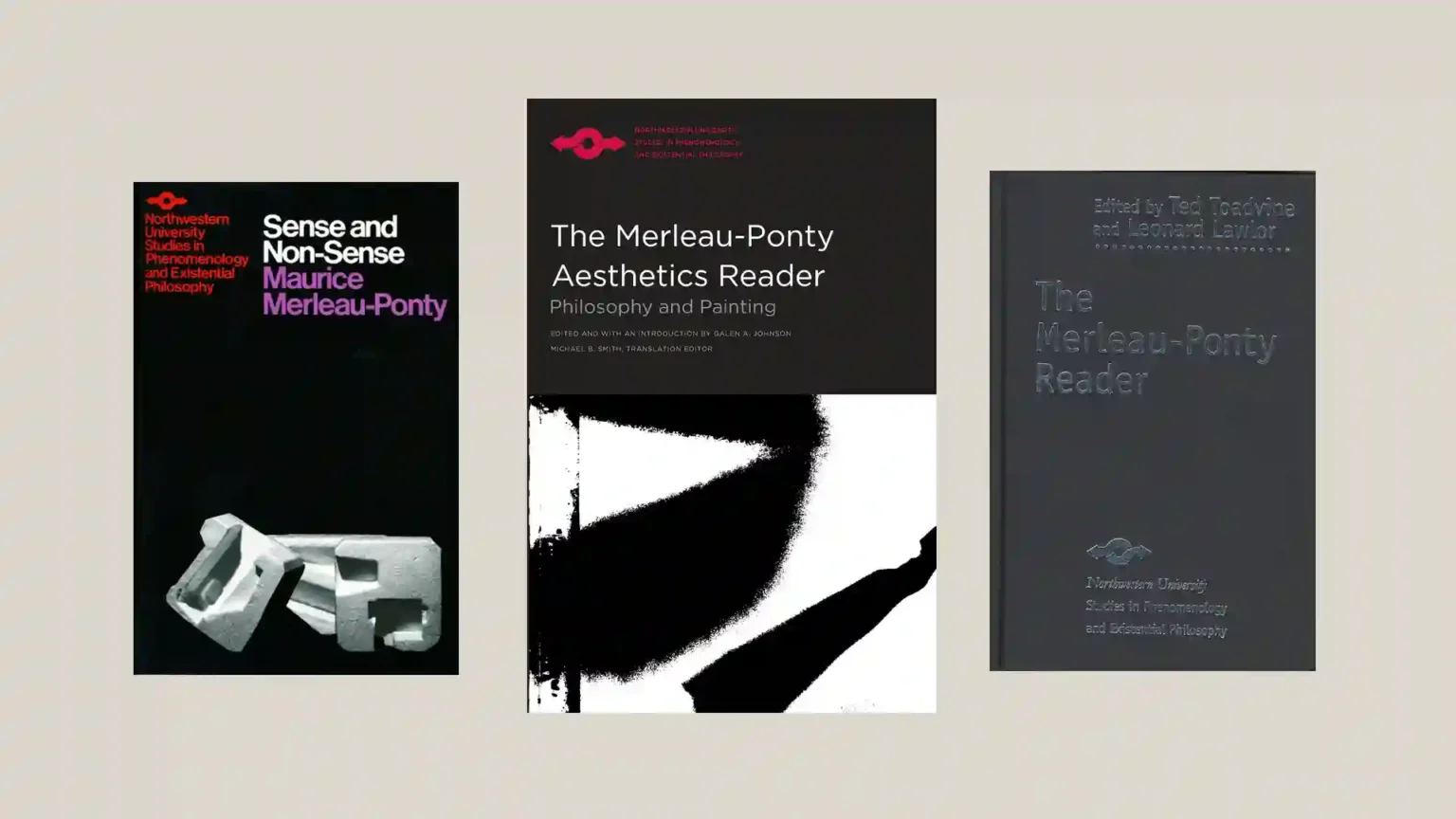
The title looks bibliographically simple. It is not. “Cézanne’s Doubt” is a 1945 essay by Maurice Merleau-Ponty, but English-language readers can encounter it in several collections, each quietly changing what the essay appears to be. The quickest answer is this: for a clean general reading copy, use Sense and Non-Sense; for art-philosophy context, use The Merleau-Ponty Aesthetics Reader; for a one-volume map of Merleau-Ponty’s career, use The Merleau-Ponty Reader. The choice matters because this short essay sits at the crossing point of perception, artistic practice, embodiment, and the problem of expression.
Bibliographic timeline: “Cézanne’s Doubt” was first published as a French essay in 1945; it was collected in Sens et non-sens in 1948. The English collection Sense and Non-Sense appeared in 1964, while the Northwestern paperback linked here is a 1992 publication. The dates describe different stages of transmission, not competing first-publication claims. Sources: Merleau-Ponty bibliography; Northwestern edition.
Merleau-Ponty’s larger philosophical position helps explain why a study of a painter belongs inside phenomenology at all. The Stanford Encyclopedia of Philosophy overview emphasizes how his work joins phenomenology to psychology, embodiment, art, language, and history. BookInLight’s own guide to phenomenology makes the same point from the reader’s side: Merleau-Ponty is not an ornamental late addition to Husserl and Heidegger; he changes what counts as philosophical evidence by taking bodily perception seriously.
In “Cézanne’s Doubt,” the painter is therefore not treated as an example pasted onto a theory already complete. Cézanne’s practice becomes a problem for theory. He paints a world before it has been tidied into the rigid opposition between a detached subject and fully formed objects. That is why Merleau-Ponty is interested in instability, repeated looking, hesitation, the stubborn return to motifs, and the effort to let spatial relations emerge through color rather than through a ready-made geometrical scheme. The Metropolitan Museum’s record for Mont Sainte-Victoire and the Viaduct is useful alongside the essay because it lets the reader inspect one of the landscapes in which Cézanne sought solidity without returning to academic perspective. Likewise, MoMA’s discussion of The Bather notes the unstable relation between figure and ground—exactly the sort of perceptual ambiguity that makes the painter philosophically interesting for Merleau-Ponty.
Choosing a Collection for Cézanne’s Doubt
The edition question becomes clearer once the surrounding texts are considered. Sense and Non-Sense presents the essay among writings on art, film, existential thought, and postwar politics. It is the most efficient choice if the immediate goal is to read the essay without constructing an entire Merleau-Ponty library. The Aesthetics Reader changes the experience: it places “Cézanne’s Doubt” beside “Indirect Language and the Voices of Silence” and “Eye and Mind,” then surrounds those primary texts with critical essays. The result makes visible a development from early phenomenology of painting toward the late ontology of visibility.
The Merleau-Ponty Reader serves a different purpose. Its chronology lets the essay appear inside the movement of a philosophical career rather than inside a thematic anthology. That is particularly valuable if the reader wants to connect the 1945 essay to later pieces such as “Eye and Mind” and to the posthumous working notes from The Visible and the Invisible. For readers already committed to the aesthetics, The Primacy of Perception is also worth keeping nearby because its title essay clarifies the broader claim that perception is not a deficient preliminary to intellectual knowledge.
An interpretive caution about Cézanne
One caution follows from the essay’s fame. Merleau-Ponty should not be turned into Cézanne’s ventriloquist. The essay is a philosophical appropriation of a painter’s practice, not a neutral report of Cézanne’s intentions. Museum collections such as MoMA’s Bathers and the Met’s late Mont Sainte-Victoire let the reader return to the paintings themselves instead of letting philosophy replace looking. That return is methodologically important: the best use of “Cézanne’s Doubt” is not to convert every brushstroke into phenomenology, but to test whether the philosophical language actually helps us see the work more precisely.
The shortest route to the essay
For most readers, then, the decision is practical. Choose Sense and Non-Sense if you want the shortest route to the essay. Choose The Merleau-Ponty Aesthetics Reader if you want the strongest art-philosophy dossier. Choose The Merleau-Ponty Reader if you want to understand where the essay stands in the evolution of his thought. Then read “Eye and Mind” next. That sequence makes the 1945 essay less like an isolated meditation on Cézanne and more like the opening of a problem Merleau-Ponty never stopped revising: how visible things become meaningful without ceasing to be visible.
There is also a translation-sensitive reason not to treat these collections as interchangeable. Merleau-Ponty’s vocabulary of perception, expression, style, and world is tightly connected to the rest of his phenomenology. A collection that supplies editorial context can prevent an art reader from taking isolated phrases as free-standing aesthetic doctrines. The Aesthetics Reader is strongest here because it places the essay inside a sequence of writings on painting and follows it with interpretive essays; the Merleau-Ponty Reader is stronger if the aim is to see how the early essay anticipates later questions of language and ontology. Neither replaces looking at Cézanne. They change the philosophical neighborhood in which the looking occurs.
If the question is specifically ‘where can I read the complete essay in English?’, favor a published collection over quotations reproduced on unsourced websites. The publisher records above establish the essay’s placement inside the books, edition context, and surrounding material. That bibliographic verification is more valuable than a scan whose provenance, pagination, or translation cannot be checked. For a citation-heavy project, record the exact collection and translator you used rather than citing ‘Cézanne’s Doubt’ as though every English version were textually identical.
Cover artwork: credits and source records
- Sense and Non-Sense — Northwestern University Press (source record)
- The Merleau-Ponty Aesthetics Reader — Northwestern University Press (source record)
- The Merleau-Ponty Reader — Northwestern University Press (source record)