Before Phenomenology of Perception, read the small set of arguments that makes Merleau-Ponty’s turn toward embodied perception intelligible.
How much should a first-time reader know before opening Maurice Merleau-Ponty’s Phenomenology of Perception? Less than the secondary literature can make it seem—and more than a glossary can supply. The useful preparation is not a complete course in Husserl, Heidegger, psychology, and French existentialism. It is a small set of conceptual contrasts that will stop the opening chapters from feeling like a quarrel whose participants have not been introduced.
Phenomenology of Perception: Start with the Reading Problem
The first decision is whether to prepare historically or functionally. A historical route begins with Husserl and Heidegger because Merleau-Ponty inherits phenomenology from them. A functional route asks what specific problems the book is trying to solve: why sensation is not an atom, why perception is organized as a figure against a ground, why the body is not merely an object, why habit can know without explicit calculation, and why the perceived world is meaningful before judgment. For most new readers, the functional route is better. The Stanford Encyclopedia entry on Merleau-Ponty notes how deeply the book draws on Gestalt theory, neurology, Husserl, and Heidegger; that is a map of sources, not a command to master them all first.
Begin with one short orientation to phenomenology. BookInLight’s phenomenology reading guide is enough to learn the recurring questions of intentionality, appearance, embodiment, world, and method. If intentionality is understood as the directedness of experience—consciousness is always consciousness of something—the Preface and the critique of classical prejudices become less opaque. Do not yet chase every Husserlian technical term.
Next, understand the target of Merleau-Ponty’s opening attack. He thinks empiricism and intellectualism make opposite mistakes that converge. One reconstructs perception from supposedly raw sensations; the other reconstructs it from acts of judgment or thought. Both miss the organized perceptual field that is already there before either theory begins. The best preparation is therefore not another abstract theory but a few concrete Gestalt examples: figure/ground reversal, perceptual grouping, and the way context changes what is seen. This is why the book’s psychological material is not decorative evidence. It is part of the philosophical argument.
Understand the lived body before the technical vocabulary
Then learn one distinction about the body: the lived body is not simply the body measured from outside. Merleau-Ponty’s claim is not that anatomy is unreal; it is that bodily existence includes capacities, orientations, habits, and a practical sense of space that are not captured by treating the body as one object among others. The publisher’s table of contents makes the progression visible: the book moves from the body as object, through motility and bodily synthesis, to sexuality, speech, space, the natural world, other people, temporality, and freedom. That sequence is already a clue to how ambitious the argument becomes.
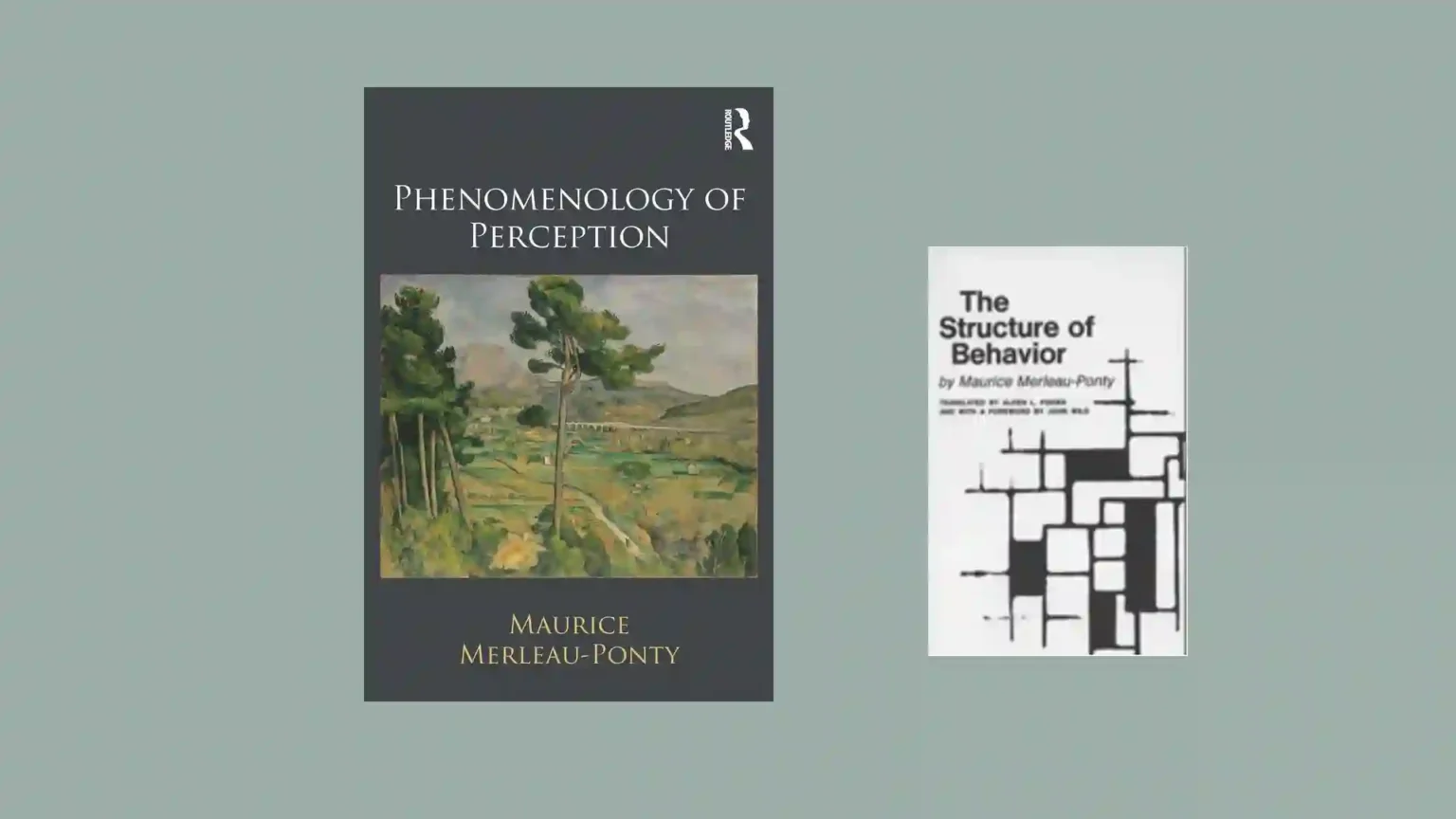
One earlier Merleau-Ponty text is worth reading if time allows: The Structure of Behavior is summarized in the SEP account as the work in which he first confronts mechanistic and intellectualist explanations through psychology and behavior. You do not need to finish it before the later book. Read enough to see that “behavior” is neither a chain of reflexes nor a hidden mental plan. It is structured engagement with an environment. That idea will return in a richer form as bodily intentionality.
For chronological orientation, The Structure of Behavior was published in French in 1942 and Phenomenology of Perception in 1945. This sequence matters because the earlier discussion of behavior and Gestalt organization is a direct intellectual precursor, not an optional later commentary. Sources: Stanford bibliography.
The hinge: read the Preface before adding more prerequisites
At this point, open the book. The worst preparation strategy is to postpone Merleau-Ponty indefinitely while completing an imaginary syllabus. Read the Preface and the Introduction. Mark every place where he distinguishes description from causal explanation, where he attacks a ready-made world, and where he insists on returning to experience before theory has divided it into subject and object. If these pages produce a specific difficulty, then add the missing background.
For Husserl, add only what the difficulty demands: intentionality, the reduction, the lifeworld, and the lived body. Research on Husserl’s Ideas II matters because embodiment and intersubjectivity are part of the phenomenological inheritance Merleau-Ponty transforms. For Heidegger, learn being-in-the-world and the idea that practical involvement precedes detached contemplation; BookInLight’s preparation guide to Being and Time is a useful selective route. Do not import Heidegger’s entire vocabulary into Merleau-Ponty. Their projects overlap, but they are not interchangeable.
What to postpone until a second pass
Finally, keep one later text in reserve rather than reading it first. The Primacy of Perception gives a compact statement of the thesis that perception is foundational, while the Merleau-Ponty Reader shows how the early philosophy develops into work on language, art, politics, and ontology. These are excellent after-the-fact clarifiers. Reading them too early can make the major book seem tidier than it is.
So the minimum route is: phenomenology vocabulary; Gestalt organization; lived body and habit; then the Preface and Introduction themselves. Add Husserl and Heidegger selectively only when the text creates a precise need. The goal of preparation is not to eliminate difficulty. It is to make the right difficulty visible. Once the reader can recognize why a body is more than an object and why a perceived world is more than assembled sensations, Merleau-Ponty’s real questions can finally begin.
One concrete case helps before the main text: Schneider, the brain-injured patient whose difficulties with abstract movement recur in Merleau-Ponty’s analysis. The point is not to diagnose Schneider from a philosophy book. It is to notice the distinction between a body that can respond to a lived situation and a body asked to perform an abstract movement detached from that situation. Merleau-Ponty uses such cases to argue that bodily motility has an intentional structure of its own. This is the sort of example that makes the phrase ‘body schema’ more than terminology: the body is organized around possible actions and practical orientations before it is represented as a geometrical object.
Cover artwork: credits and source records
- Phenomenology of Perception — Routledge (source record)
- The Structure of Behavior — Duquesne University Press (source record)