Five books on Camus and the absurd give different answers about revolt, suicide, meaning, and the limits of philosophical consolation.
In 1942, under wartime conditions, Camus published The Stranger and The Myth of Sisyphus within months of each other. That fact is more than biographical decoration: the novel and essay stage related problems in different forms. The Stanford Encyclopedia account of Camus describes the absurd as a confrontation between the human demand for clarity and a world that does not answer it.
1. The Myth of Sisyphus — the conceptual center
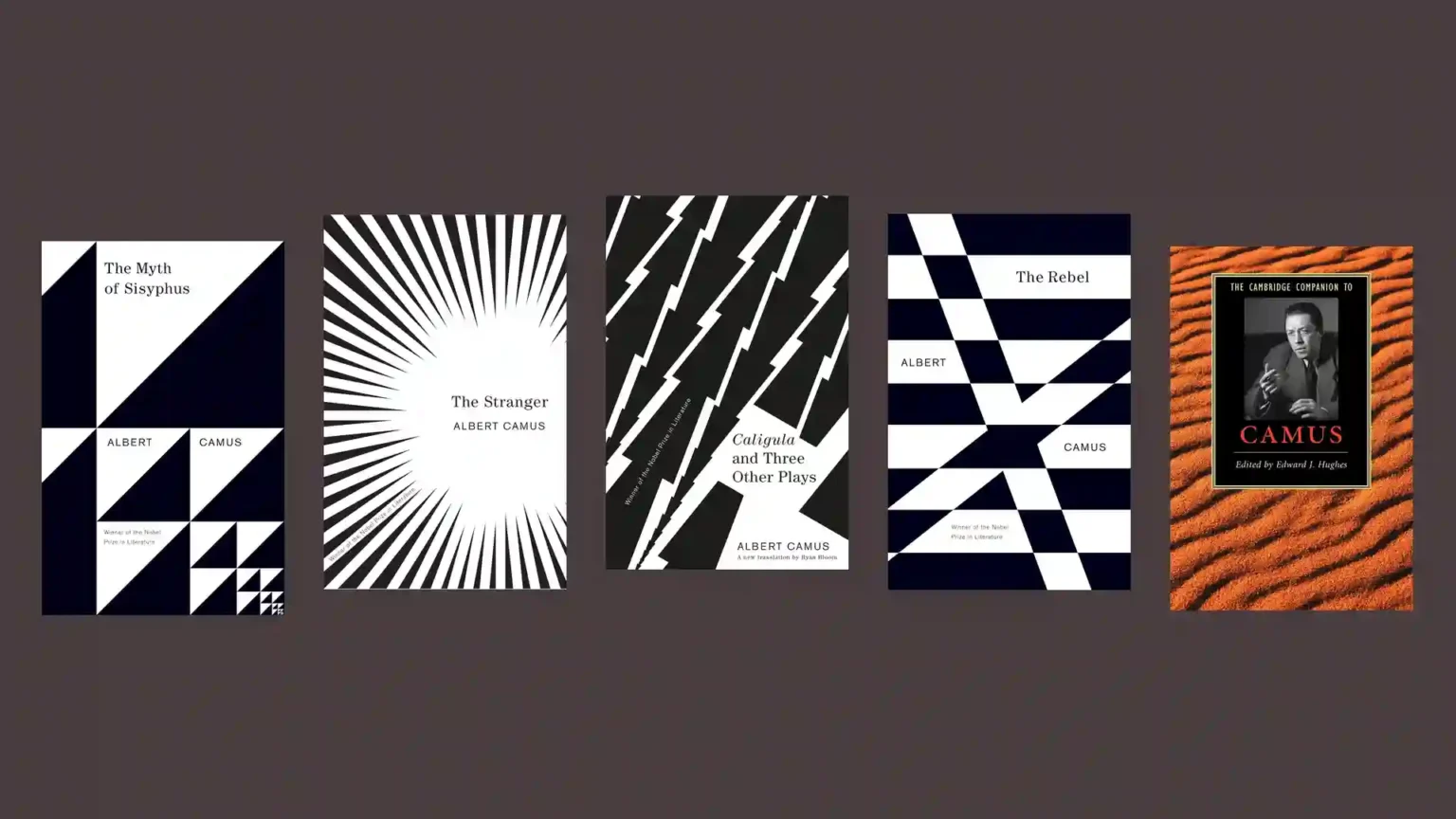
Start with the essay itself. The current Penguin edition is an accessible English route. Read for the movement from the question of suicide to the rejection of “philosophical suicide,” then to revolt, freedom, and passion. Do not reduce the book to the image of Sisyphus smiling; the image comes after a sustained attempt to define what it would mean to live without appeal.
2. The Stranger — absurdity without a glossary
Pair the essay with the novel because Meursault is not a diagram of Camus’s doctrine. The comparison is productive precisely where it fails. The novel gives you atmosphere, estrangement, social judgment, bodily immediacy, and death; the essay gives conceptual claims. Reading them alternately prevents the fiction from being flattened into an allegory.
3. Caligula — when absurd reasoning becomes political
The play stresses a counterexample: if nothing has ultimate meaning, does that license domination? Camus’s answer develops through dramatic extremity. Put beside The Myth of Sisyphus, Caligula helps distinguish recognition of absurdity from nihilistic permission.
4. The Rebel — from suicide to murder
The SEP article on Camus emphasizes that The Rebel picks up the earlier problem at a new scale. If the first great question is whether to kill oneself, the later political question is what can justify killing others. Rebellion becomes a way of seeking limits and solidarity without returning to metaphysical guarantees.
5. A serious philosophical study of Camus
End with scholarship, not because scholarship supplies the “correct” Camus, but because it exposes interpretive fault lines: whether Camus is a philosopher at all, whether the absurd is argued or staged, how far he differs from existentialists, and whether his ethics of limits can support political judgment. The Stanford entry is already a useful map of these disputes and its bibliography can guide the next monograph.
| If your main question is… | Read next |
|---|---|
| Why keep living? | The Myth of Sisyphus → The Stranger |
| Can absurdity justify anything? | Caligula → The Rebel |
| Is Camus an existentialist? | SEP Camus → Sartre/existentialism scholarship |
| How does absurdity become an ethics? | The Rebel → later scholarship |
A comparison with Thomas Nagel is especially useful as a stress test. Nagel’s “The Absurd” also rejects weak arguments about cosmic insignificance, but his account turns on our capacity to step back from our own reasons. Camus’s absurd is not identical. The shared word should sharpen the difference, not erase it. For the original essay and its placement in Mortal Questions, see the Nagel “Absurd” text guide.
Choose your route according to the question that survives. For literary form, move between The Stranger and Caligula. For ethics, move from The Myth of Sisyphus to The Rebel. For conceptual comparison, put Camus beside Nagel or Sartre. The goal is not to collect “absurdist books.” It is to learn how one word changes when fiction, essay, drama, and political thought make different demands on it.
A sixth text could easily be added, but the five-book structure works because each item changes genre or scale. The essay defines the problem, the novel stages estrangement, the play tests political license, The Rebel moves to historical violence, and scholarship reconstructs the disputes. Repetition would add titles without adding interpretive function.
Camus’s relation to existentialism also deserves resistance. He shared problems and a historical milieu with existentialists but rejected the label. The SEP Camus article explains both the proximity and the distance. A reading list should therefore avoid filing every text under “existentialism” merely because it addresses death, meaning, and freedom.
The Stranger also exposes the limits of philosophical extraction. Meursault’s style, colonial setting, affect, and legal condemnation cannot be reduced to an example of “the absurd.” A reader who treats the novel as a coded version of the essay loses precisely what fiction contributes: ambiguity that no conceptual glossary exhausts.
Likewise, The Rebel is not simply “Camus after the absurd.” It asks whether revolt can generate limits without producing absolute historical projects that justify murder. That question is why the book became politically explosive and why Camus’s break with Sartre matters to intellectual history, not just literary biography.
The route ends by separating two uses of the word absurd. In everyday speech it often means pointless or ridiculous. In Camus it names a relation between demand and silence. In Nagel it names tension between engaged seriousness and reflective distance. Keeping those uses apart is the minimum price of a serious reading list.
There is also a chronological gain in reading the five works as a sequence. The absurd cycle of the early 1940s is followed by the revolt cycle, where individual lucidity is tested against collective violence and historical ideologies. Camus’s questions remain continuous, but the political stakes intensify.
For that reason, biography can be useful only when it illuminates intellectual transitions: journalism in Algeria, Resistance-era Paris, the break with Sartre, and debates about revolutionary violence. Biography becomes a distraction when it substitutes personality for argument. Use it to date problems, not to psychologize every claim.
Readers drawn to the famous final image of Sisyphus should also read backward. The declaration of happiness is earned by prior refusals—of suicide, hope as escape, and philosophical leaps. Detached from those refusals, the line becomes motivational merchandise. The Camus overview helps restore the argumentative sequence.
Cover artwork: credits and source records
- The Myth of Sisyphus — Vintage (source record)
- The Stranger — Vintage (source record)
- Caligula and Three Other Plays — Vintage (source record)
- The Rebel — Vintage (source record)
- The Cambridge Companion to Camus — Cambridge University Press (source record)