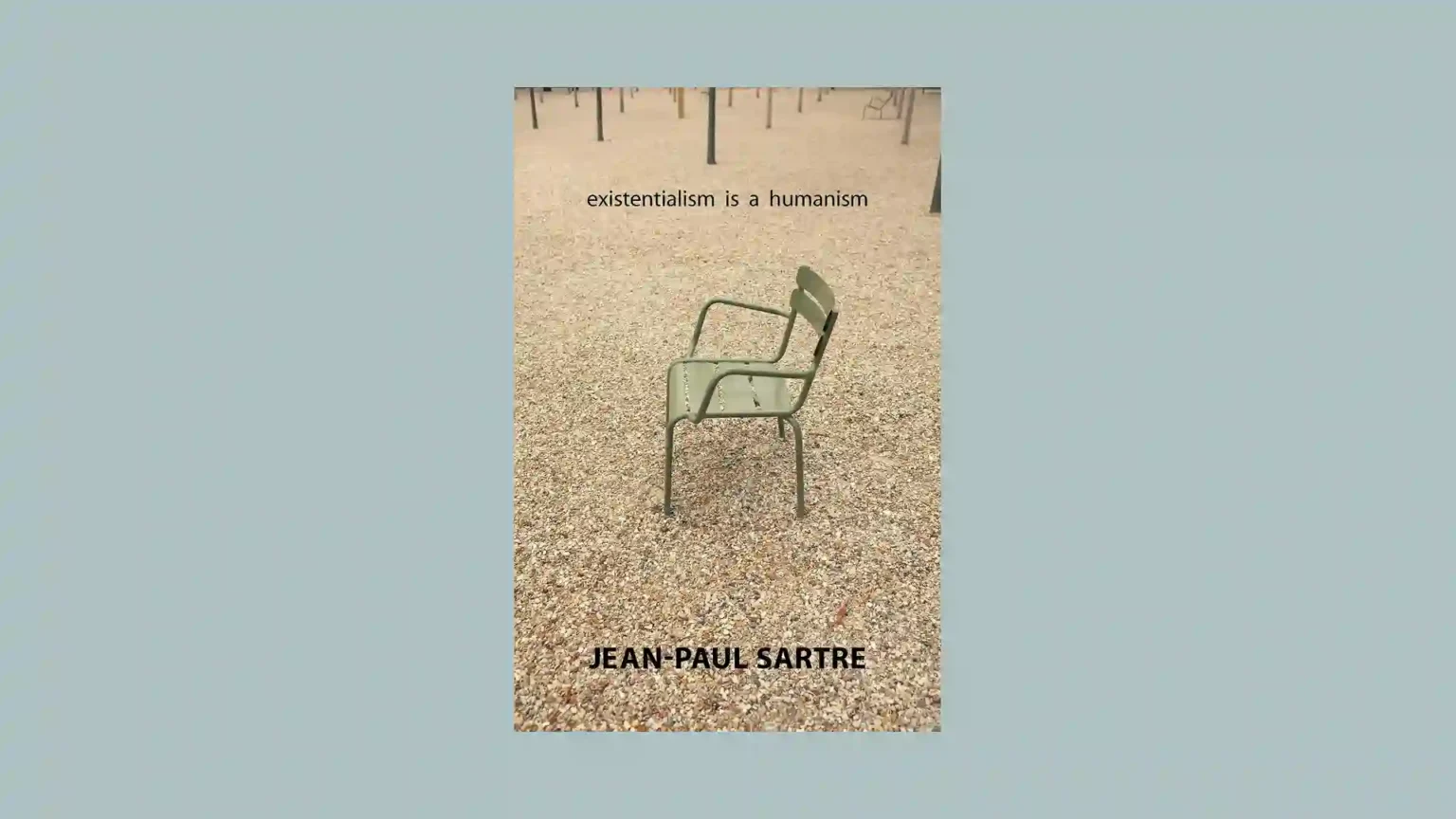
Existentialism Is a Humanism is accessible in several editions, but Sartre’s lecture should not stand in for his whole philosophy.
In 1945 Sartre delivered a public lecture defending existentialism against charges that it led to despair, irresponsibility, and moral subjectivism. That historical setting matters because Existentialism Is a Humanism is not a miniature version of Being and Nothingness. It is a public intervention. The Yale University Press edition, translated by Carol Macomber, is a reliable standalone English route into the lecture.
What the lecture does very well
It gives readers several claims in unusually direct form: existence precedes essence; human beings make themselves through choices; freedom brings responsibility; and choosing projects also commits us to views about value. The Stanford Encyclopedia entry on existentialism is a strong companion because it distinguishes those public formulations from the more technical ontology behind them.
The lecture is especially good for testing a common misunderstanding: freedom does not mean getting whatever one wants. Sartre’s later and more technical work insists on facticity and situation. The contemporary SEP entry on Sartre explains that his early theory is freedom within a factual situation, not magical independence from bodies, histories, or institutions.
What it cannot stand in for
It cannot substitute for Being and Nothingness on bad faith, being-for-itself, being-for-others, or the ontology of negation. It cannot substitute for Beauvoir on the ethical and social conditions of freedom. And it cannot substitute for Sartre’s later political writing, where the abstract language of freedom is revised under pressure from class, colonialism, and historical conditioning.
That does not make the lecture “simplistic.” It means its genre matters. A public defense selects arguments for intelligibility and controversy. A philosophical treatise builds machinery that a lecture has no time to reconstruct.
Which edition should a first-time reader choose?
The Yale edition is useful because the lecture is presented as a small book with editorial framing rather than as a floating web transcript. The Macomber translation is readable, and the volume includes contextual material. For conceptual verification, pair it with the SEP existentialism entry. For claims specifically about Sartre’s ontology and later development, use the Sartre entry.
Four propositions to test while reading
“Existence precedes essence” denies a fixed human nature that determines what each person must become; it does not deny every biological or historical fact.
Freedom generates responsibility because projects are not merely events that happen inside us; they express what we take to count as reasons and values.
Anxiety is not just nervousness. It is tied to recognizing that no external moral script can relieve us of choosing.
Humanism is the most unstable word in the title: Sartre defends one kind of humanism while rejecting pictures of humanity built around a fixed essence or pre-given moral purpose.
The decisive evidence therefore points in two directions at once. Read the lecture because it is Sartre at maximum public clarity. Refuse to make it carry the whole weight of Sartre because its clarity is produced by compression. Stop there if you want a defensible introduction; continue to Being and Nothingness if you want to know what makes those slogans philosophically possible.
The lecture’s most famous formula also needs grammatical care. “Existence precedes essence” does not mean that human beings have no characteristics until consciously chosen. It means there is no pre-given essence or divine design that fixes what a human life ought to be. Facticity remains; what disappears is the idea that facticity arrives with a complete normative script.
The claim about choosing for humanity is even more controversial. Sartre suggests that in choosing we affirm an image of what we take a human being ought to be. Critics have long asked whether this really follows from individual choice. The lecture should therefore be read as a defense under pressure, not as a sequence of axioms every later Sartrean text simply repeats.
The SEP existentialism entry is especially useful on this point because it situates Sartre beside Beauvoir and Merleau-Ponty, where freedom becomes increasingly mediated by concrete situations and relations to others. That wider frame corrects the caricature of existentialism as solitary decisionism.
The edition question finally depends on purpose. For classroom reading, the Yale volume’s compactness and apparatus are advantages. For historical research, consult French publication history and variant contexts. For philosophical depth, pair the lecture with the relevant sections of Being and Nothingness. No single edition can turn a public lecture into a complete system, and that is not a defect of the edition.
Sartre’s examples of the coward and the hero are useful because they expose another misunderstanding. He is not saying that a single conscious decision instantly remakes character. He is rejecting the idea that character excuses us by operating as an immutable inner essence. Patterns of action make a person, and new action remains possible, though never costless or context-free.
The lecture’s treatment of responsibility is therefore both powerful and vulnerable. It dramatizes the impossibility of hiding behind a fixed nature, yet it can sound as if social constraint disappears. Later existentialist work complicates that picture. The SEP account tracks the move toward situated freedom and makes clear why Beauvoir and Merleau-Ponty are essential companions.
Readers should also notice the rhetorical opponents in the lecture. Sartre is answering Christians, Marxists, and public critics of existentialism in postwar France. Claims are shaped as replies to accusations—quietism, despair, arbitrariness. Knowing that debate helps explain why the text repeatedly insists on action and responsibility rather than patiently reconstructing ontology.
That historical situation is another reason to prefer an edition with editorial framing. A clean transcript gives you words; a contextual edition gives you the argumentative occasion. The Yale volume earns its place not because it is magically definitive but because it makes genre and reception harder to ignore.
Cover artwork: credits and source records
- Existentialism Is a Humanism — Yale University Press (source record)