Before Zhuangzi, learn enough about early Chinese intellectual debates to orient yourself without deciding the book’s meaning in advance.
The first decision is whether to prepare for the Zhuangzi by reading another whole tradition first. Usually, no. The book is difficult partly because it resists the expectation that philosophy should present one doctrine in one authorial voice. The Stanford Encyclopedia of Philosophy entry on Zhuangzi emphasizes the text’s philosophical breadth and the complexity of its composition; Brook Ziporyn’s complete Hackett translation is designed to let that multivocal structure remain visible. Preparation should therefore remove avoidable confusion without explaining away the strangeness that makes the work worth reading.
Which Zhuangzi should be on the desk before anything else?
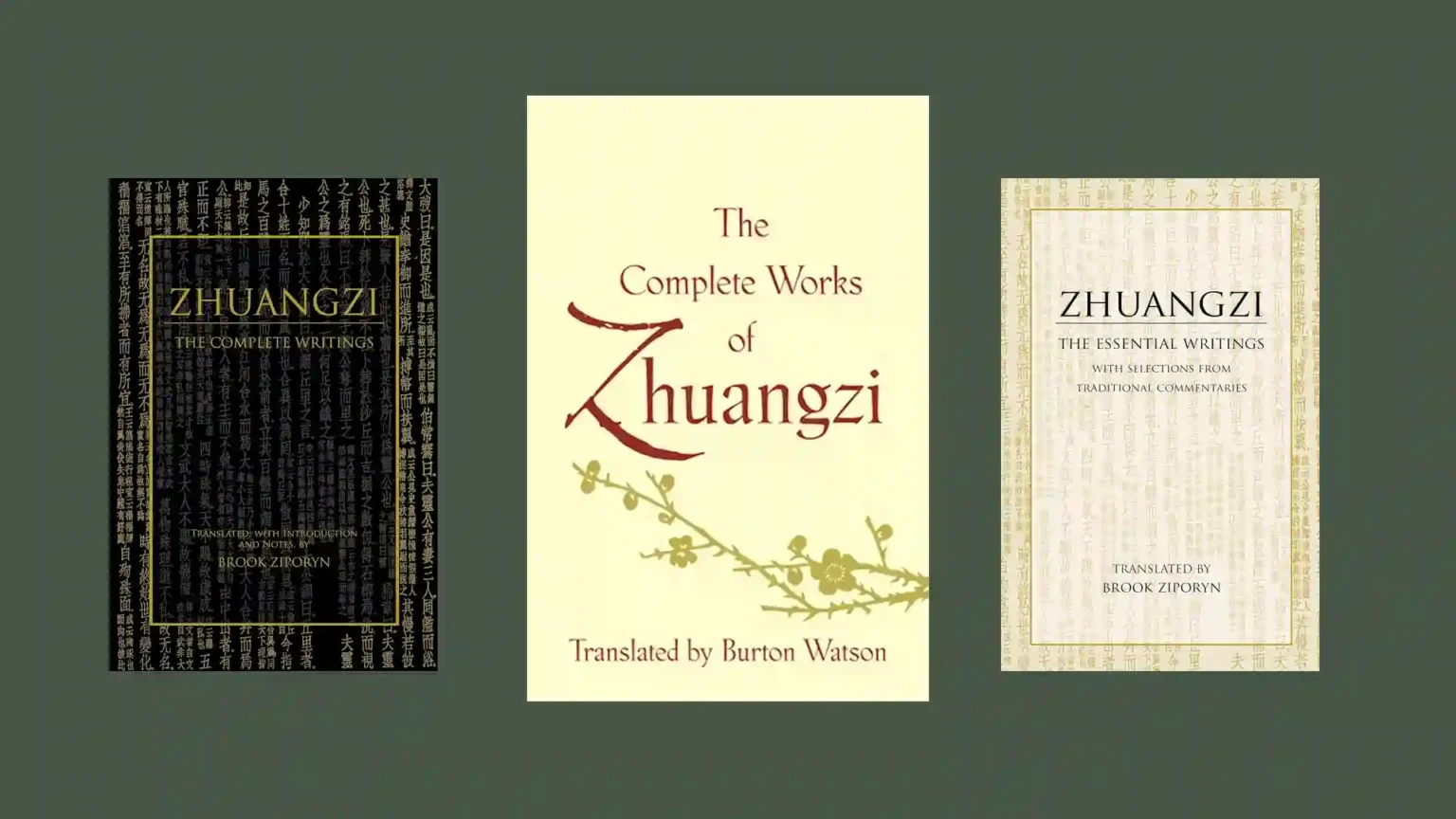
For an experienced reader who wants one current working text, choose Ziporyn’s Zhuangzi: The Complete Writings. It is complete, annotated, and unusually attentive to translation problems. If traditional commentary is more important than completeness on the first pass, his earlier Zhuangzi: The Essential Writings includes the Inner Chapters, substantial selections, and curated commentarial material. Burton Watson’s The Complete Works of Zhuangzi remains valuable because its English prose has shaped Anglophone reception for decades and is often clearer at first contact. The sensible choice is not to hunt for a perfectly transparent translation; it is to know which interpretive instrument you are holding.
That is why the first prerequisite is not another philosopher. It is a translation note. Hackett’s support material for Ziporyn’s Essential Writings explicitly addresses the translation and the question of “Zhuangzi as philosopher.” Ten minutes spent there can save hours of assuming that recurring English words represent stable Chinese equivalents.
Should you read the Dao De Jing first?
Read some of it, not because the Dao De Jing is a textbook for Zhuangzi, but because modern readers often merge the two into a single generic “Daoism.” BookInLight’s Tao Te Ching: A Philosophy of Non-Forcing is useful as orientation precisely if you keep the differences visible. The Dao De Jing’s compressed political-cosmological aphorisms and Zhuangzi’s comic stories, perspectival disruptions, technical dialogues, and textual layers do not perform the same philosophical work.
A short comparison helps with three terms you will meet repeatedly: dao (way/course), de (power/virtue), and wuwei (non-forcing/non-action). Learn that their English equivalents are provisional. Then stop preparing. If you read the entire Daoist tradition before opening Zhuangzi, the preparation begins to dictate the result.
Do you need Confucius and the Analects?
You need recognition, not mastery. Zhuangzi repeatedly stages encounters with Confucius or Confucian figures, but these scenes do not function as simple anti-Confucian cartoons. Sometimes “Confucius” is corrected; sometimes he voices an insight that sounds strikingly Zhuangzian. The useful preparation is therefore a small sample of the Analects—enough to recognize ritual, cultivated personhood, learning, and moral exemplarity—rather than a full survey of Confucian philosophy.
Read a handful of Analects passages on ritual (li), humaneness (ren), learning, and the exemplary person (junzi).
Notice that a historical Confucius and a literary “Confucius” inside Zhuangzi are not automatically the same object.
Treat parody as evidence of engagement, not proof that one school simply rejects another.
What conceptual background is worth learning in advance?
Only the concepts that prevent false puzzles. The SEP Zhuangzi overview is enough for this first pass. Learn why perspective, skill, language, death, transformation, and spontaneity recur. Do not turn them into a glossary of doctrines. A concept such as “perspectivism” can help name a pattern, but it can also make the text look as if every standpoint were equally true. A concept such as “skepticism” can illuminate Zhuangzi’s destabilization of certainty, but it can also import a Western problem structure too quickly.
If you are coming from a general philosophy curriculum, BookInLight’s beginner map of philosophy books can supply a useful contrast: Plato, argument-driven modern philosophy, and Chinese classics teach different reading habits. Zhuangzi rewards attention to voice, narrative reversal, wordplay, and the failure of distinctions inside the scene—not only extraction of premises and conclusions.
Which chapters should come first?
Start with the Inner Chapters, but do not pretend that “Inner” means “certainly written by a single historical Zhuang Zhou.” The traditional division is editorial and text-historical. It remains useful because chapters 1–7 concentrate many of the motifs that later chapters expand, contest, parody, or redeploy. A productive first route is deliberately incomplete:
Chapter 1 for scale, perspective, usefulness, and the instability of ordinary measures.
Chapter 2 for language, disputation, distinctions, and the shifting “this/that” field. Read slowly.
Chapter 3 for skilled activity: Cook Ding is famous because embodied responsiveness complicates the idea that knowledge is primarily explicit rules.
Chapter 6 for transformation, death, friendship, and the difficulty of separating metaphysics from a style of life.
Then jump outside the Inner Chapters. The point is to experience the larger collection before deciding that chapters 1–7 define its single doctrine.
What can you safely postpone?
You can postpone a full history of early Chinese philosophy, manuscript studies, the complete commentarial tradition, and debates over authorship. You can also postpone the urge to decide whether Zhuangzi is a relativist, skeptic, mystic, naturalist, therapeutic philosopher, or anti-rationalist. Those labels become useful only after they have something textual to answer to.
You should not postpone translation comparison forever. After the first several chapters, take one passage—Cook Ding, the butterfly dream, the fish dialogue, or a difficult stretch of chapter 2—and compare Watson with Ziporyn. The discrepancies are pedagogically useful. They reveal where the English has made decisions about grammar, technical terms, tone, and ambiguity. This is the point at which “which translation?” becomes a philosophical question rather than a shopping question.
What is the minimum route?
The minimal route is therefore short: choose a defensible translation; read a little Dao De Jing and a little Analects to prevent crude school labels; learn only a few recurring conceptual problems; read the Inner Chapters selectively; then compare translations after the text has already surprised you. Do not read six introductions before chapter 1. Zhuangzi’s jokes, reversals, monsters, craftsmen, dreamers, disputants, and impossible conversations are not examples added after a theory. They are part of how the thinking happens.
For most serious first-time readers, the calibrated choice is Ziporyn’s complete translation as the main text, Watson as a prose-control when a passage becomes opaque, and the SEP article as orientation after—not before—several chapters. The preparation has done its job when it becomes unnecessary.
How much textual history do you need before chapter 1?
Only enough to stop treating “Zhuangzi” as the voice of a single modern-style author. The received book contains thirty-three chapters conventionally divided into Inner, Outer, and Miscellaneous groupings, and scholarship has long debated layers of composition and editorial history. The SEP article is useful because it lets a beginner hold two ideas at once: there is a historical figure associated with the text, and the book we read is a composite tradition whose voices cannot simply be flattened into that figure. You do not need a stemma of manuscripts before reading; you do need to avoid sentences such as “Zhuangzi says” when the attribution is doing more work than the evidence can support.
This changes the reading habit. When two passages seem to contradict one another, do not rush to manufacture a hidden synthesis. First ask whether the contradiction might belong to the collection’s multivocal structure. Ziporyn’s complete translation is particularly good for this problem because its notes and terminology keep interpretive alternatives visible. The point is not that coherence is impossible. It is that coherence should be earned passage by passage rather than assumed from the name on the cover.
What should you learn from the skill stories?
Cook Ding is the famous case, but he is not a detachable parable about “flow.” The butcher’s skill raises questions about explicit rules, embodied responsiveness, perception, habituation, and what happens when action no longer requires conscious deliberation at every step. Read the passage once for the story; read it again asking exactly what is learned, what is no longer consciously seen, and whether the performance depends on years of practice rather than spontaneous anti-intellectualism. That second reading prevents the modern self-help version from swallowing the philosophical difficulty.
Other skill passages complicate the lesson. Craftsmen, swimmers, ferrymen, and experts repeatedly appear, but expertise can expose both attunement and narrowness. A person may be extraordinarily responsive inside one practice and still mistake that local mastery for a universal measure. This is where Zhuangzi’s interest in perspective meets the skill material: successful action does not automatically authorize a metaphysics. The book keeps asking what a capacity lets someone see—and what it prevents them from seeing.
When should you compare Watson and Ziporyn?
Not on every sentence. Translation comparison becomes useful when a passage is carrying philosophical weight. Burton Watson’s complete translation often gives the first-time reader a lucid narrative line; Ziporyn’s complete Hackett version is more willing to preserve lexical play, conceptual ambiguity, and interpretive friction. If both versions seem equally clear, keep reading. If they diverge sharply, stop and treat the divergence as part of the evidence.
Three kinds of difference deserve attention. First, repeated Chinese terms may be rendered with different English words, hiding a conceptual echo. Second, an English noun may make a fluid construction look like a fixed entity. Third, tone matters: a passage can become solemn, comic, skeptical, or mystical through choices that are individually defensible but cumulatively powerful. Hackett’s translation support material is valuable because it makes such choices discussable rather than invisible.
This is also why the Tao Te Ching article at BookInLight should be used as a neighboring text, not as a dictionary. Shared vocabulary does not guarantee shared argument. Reading the two together is productive only when “Daoist” remains a historical and interpretive question rather than a container into which every paradox about spontaneity, language, or non-forcing is poured.
Cover artwork: credits and source records
- Zhuangzi: The Complete Writings — Hackett (source record)
- The Complete Works of Zhuangzi — Columbia University Press (source record)
- Zhuangzi: The Essential Writings — Hackett (source record)