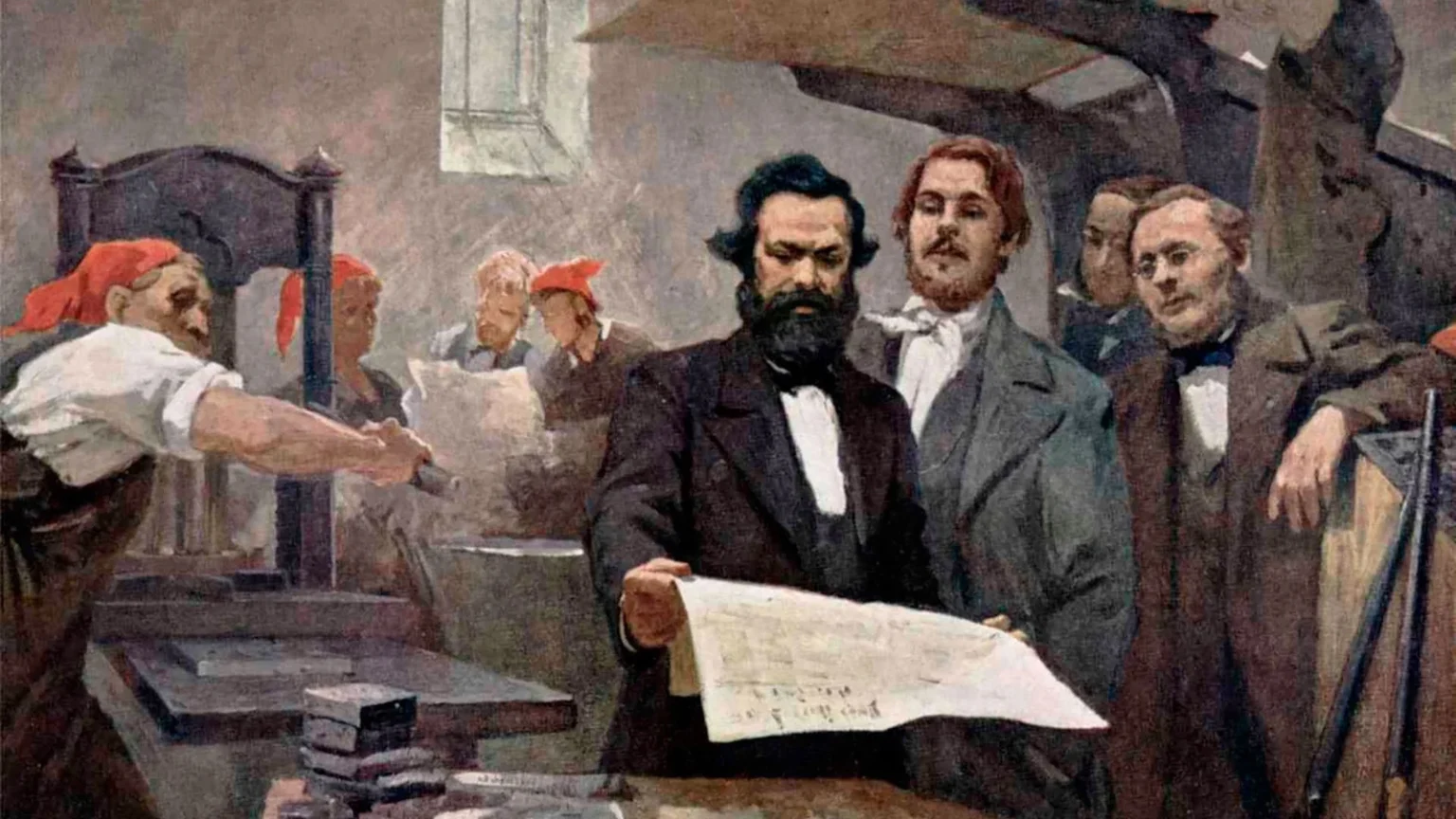
Marxism for Beginners becomes much easier once Marx himself is separated from the political systems, parties, later doctrines, and twentieth-century controversies that inherited his name. Begin with a short intellectual map, not Capital; then move from Marx and Engels through political economy, revolutionary state theory, and Gramsci’s account of hegemony. The point is not ideological initiation but learning how a tradition develops by argument, revision, and disagreement.
Introduction
Marxism is unusually difficult to enter because the name refers to several things at once. It can mean Karl Marx’s own philosophical and economic writings; the collaboration of Marx and Friedrich Engels; theories of history and class; socialist political movements; Leninist theories of party and state; Western Marxist traditions concerned with culture and ideology; or the doctrines institutionalized by governments that called themselves Marxist. Treating these as one finished doctrine creates confusion before the reading has begun.
A beginner therefore needs distinctions rather than slogans. The Stanford Encyclopedia of Philosophy’s account of Karl Marx is useful because it presents alienation, historical development, political economy, class and communism as connected but distinct problems. Likewise, the history of Marxism cannot be reduced to what Marx wrote before his death in 1883. Engels’s editorial work, Second International debates, the Russian Revolution, anti-colonial movements, Western Marxism, feminism, critical theory and later cultural theory all changed the meaning of the tradition.
This is therefore a reading path rather than a ranking. The sequence starts with Peter Singer because a beginner first needs an intelligible map of Marx’s intellectual project. It then moves to The Communist Manifesto for political rhetoric and historical argument; David McLellan’s Karl Marx: Selected Writings for the development of Marx’s ideas across genres; the first volume of Capital for mature political economy; Lenin for the transformation of Marxist arguments about state power and revolution; and Gramsci for the problem of consent, civil society, culture and hegemony.
That order also protects the reader from a common historical mistake: reading twentieth-century Marxism backward into Marx. The distinction matters. Lenin is not simply Marx translated into Russian conditions, and Gramsci is not merely Lenin with more attention to culture. Each inherits unresolved problems and reconstructs them under different political pressures.
The shortest honest answer
Start with Peter Singer’s Marx: A Very Short Introduction. Then read The Communist Manifesto, McLellan’s Karl Marx: Selected Writings, Capital, Volume 1, Lenin’s The State and Revolution, and Gramsci’s Selections from the Prison Notebooks. The sequence moves from orientation to primary encounter, intellectual development, political economy, revolutionary state theory, and finally the Marxist analysis of hegemony and civil society.
For Marxism for Beginners, six books are enough to establish the architecture without pretending to cover every branch. Do not delay Marx until you have read Hegel, Smith, Ricardo, nineteenth-century European history and every major socialist predecessor. Learn background when a text actually demands it. The reading itself should generate the questions that determine what background comes next.
Before you start: how to approach Marxism for Beginners
The first rule is to stop treating “Marxism” as though it were a book Marx wrote. Marx did not leave a complete system containing a finalized philosophy of history, economics, politics, culture and revolutionary strategy. His published works, journalism, notebooks, correspondence and unfinished manuscripts change emphasis over four decades. Engels systematized some arguments; later Marxists systematized them further.
Chronology is therefore useful but insufficient. A strictly chronological route would send a beginner through youthful philosophy, obscure polemics, journalism and abandoned drafts before reaching the writings that explain why Marx became historically important. A better order alternates orientation and primary reading. Learn enough of the early Marx to understand alienation and historical materialism, but do not assume those concepts transparently explain the mature critique of political economy.
Before Capital, learn six distinctions: commodity and use-value; value and price; concrete and abstract labor; labor and labor-power; necessary and surplus labor; money and capital. BookInLight’s reader’s route into Capital, Volume I develops those dependencies in detail. A short look at the history of British factory legislation also makes Marx’s long chapters on the working day more concrete.
The other crucial precaution is political: do not use later outcomes as shortcuts for interpreting earlier texts. The Soviet Union is indispensable to the history of Marxism, but it cannot substitute for reading Marx; neither can admiration for Marx settle questions about Lenin or twentieth-century communist states. Intellectual history requires reconstructing arguments before judging their consequences.
The best first book on Marxism for Beginners
Start with: Marx: A Very Short Introduction by Peter Singer
Singer is the best starting point because he gives the beginner an argument-shaped map rather than a glossary. He connects Marx’s engagement with Hegel, alienation, historical materialism, political economy, class, revolution and communism while repeatedly asking how these parts are supposed to cohere. That is precisely the problem a new reader needs solved before confronting fragments from different decades.
The limitation is interpretive. Singer famously emphasizes Marx’s concern with human freedom and alienation, and readers should not treat that emphasis as uncontested. Structuralist, value-form, analytical and other Marxist traditions reconstruct Marx differently. That is a reason to read Singer first, not a reason to avoid him: a strong introduction should provide a position clear enough to be challenged later.
Use the 2018 second edition from Oxford University Press. It updates Singer’s assessment of Marx’s relevance and explicitly revisits the intellectual and political legacy of Marxism. Read it completely, then move immediately to The Communist Manifesto. The contrast between Singer’s retrospective reconstruction and Marx and Engels’s urgent political prose is productive.
The core reading sequence

Book 1
Marx: A Very Short Introduction by Peter Singer
Edition shown: Oxford University Press / second edition / 2018 / paperback / ISBN 9780198821076
Place in the sequence: Orientation before primary reading
Singer’s short introduction solves the first problem of Marxist reading: Marx’s writings do not arrive as a finished system. The young journalist arguing about censorship and religion, the author of the 1844 manuscripts on alienated labor, the collaborator writing historical polemics with Engels, and the mature critic of political economy do not simply repeat the same propositions in different vocabulary. Singer gives the beginner a chronological and conceptual frame in which those shifts can be seen.
Pay particular attention to the chapters on Hegel, alienation, historical materialism and economics. Singer’s account helps distinguish Marx’s criticism of capitalism from a merely distributive complaint that some people possess too much wealth. The deeper issue is how production, property, exchange, labor and social dependence organize human activity. That emphasis will later make Capital intelligible as an analysis of social forms rather than a long denunciation of greedy employers.
Singer is also usefully willing to ask which Marxian predictions and arguments survive historical scrutiny. Beginners often encounter Marx either as a prophet who must be defended or as a thinker disproved by the twentieth century. Singer refuses both shortcuts. His judgments can certainly be contested, but he models the right intellectual posture: separate claims about capitalism, history, freedom and political transition instead of accepting or rejecting “Marxism” wholesale.
Read the whole book. It is short enough that selective reading would defeat its purpose. Make notes on terms that remain unstable—alienation, materialism, class, ideology, exploitation, communism—and resist fixing final definitions yet. Marx’s own writings will complicate them. After finishing Singer, move directly to The Communist Manifesto; the shift from explanatory overview to political intervention is the first important change of genre in the sequence.
Difficulty: Beginner
“identifies the central vision that unifies Marx’s thought, enabling us to grasp Marx’s views as a whole.”
— Oxford University Press • Oxford Academic
Book 2
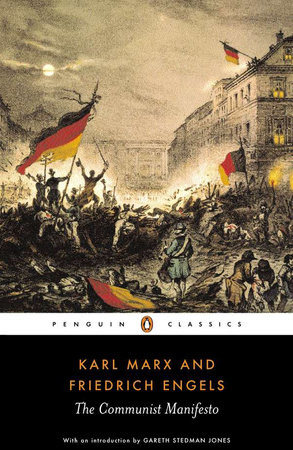
The Communist Manifesto by Karl Marx and Friedrich Engels
Edition shown: Penguin Classics / Samuel Moore translation / introduction and notes by Gareth Stedman Jones / 2004 / paperback / ISBN 9780140447576
Place in the sequence: First primary encounter with class, capitalism and revolutionary politics
The Manifesto is the right first primary work because it is short, rhetorically forceful and historically revealing. It also introduces one of Marxism’s decisive changes of perspective: political life is interpreted through class relations and transformations in production rather than through constitutional principles alone. The bourgeoisie appears as a revolutionary historical force before it appears as an object of communist opposition. Capitalism breaks inherited bonds, internationalizes markets, reorganizes production and subjects social life to continuous change.
That double vision matters. Beginners sometimes expect Marx and Engels to describe capitalism as a static evil. Instead, the first section is fascinated by its dynamism. Their argument is that capitalism generates extraordinary productive capacities while organizing them through class domination, insecurity and recurrent conflict. Read the famous formulations in that tension; otherwise the book becomes a collection of slogans.
The second section is equally important because it addresses recurring objections about property, family, nationality and communist political aims. The later taxonomy of socialist movements is more historically dated, but it teaches a durable lesson: “socialism” was already a field of competing doctrines. Marx and Engels distinguish rival socialist projects by asking whose interests they express and what historical forces could realize them.
Do not use the Manifesto as a miniature version of Capital. It was written for the Communist League in 1848, under revolutionary expectations that shape both its compression and its political predictions. Read the primary text first in one or two sittings, then read Gareth Stedman Jones’s substantial introduction. The apparatus is deliberately placed second in this reading path so that historical contextualization sharpens rather than pre-empts the encounter.
Difficulty: Beginner
“The Communist Manifesto still remains a landmark text: a work that continues to influence and provoke debate on capitalism and class.”
— Penguin Classics • Penguin Books

Book 3
Karl Marx: Selected Writings by Karl Marx
Edition shown: Oxford University Press / edited by David McLellan / second edition / 2000 / paperback / ISBN 9780198782650
Place in the sequence: Follow Marx’s intellectual development across philosophy, politics and economics
McLellan’s reader belongs before Capital because Marx is easier to understand when the mature economic categories are seen as the result of an intellectual development rather than dropped onto the reader fully formed. The selection ranges across journalism, philosophy, the 1844 manuscripts, historical materialism, revolutionary politics, political economy, correspondence and later reflections. It makes visible both continuities and changes that disappear when Marx is encountered only through famous quotations.
Do not read all 687 pages mechanically. Begin with the selections from the 1844 manuscripts on estranged labor, the “Theses on Feuerbach,” material from The German Ideology, the 1859 preface to A Contribution to the Critique of Political Economy, political writings on France, and representative extracts from Capital. Then use the rest according to questions raised by those texts. The reader’s advantage is precisely that it lets one move between periods without pretending that excerpts replace complete works.
The major interpretive question is the relation between the early and mature Marx. Some traditions emphasize continuity from alienation and human emancipation to the critique of capital; others insist that the mature theory reorganizes the early philosophical vocabulary so extensively that continuity becomes misleading. McLellan’s chronological organization makes that disagreement visible rather than deciding it by fiat.
This edition also prepares the reader for a crucial habit: attending to genre. A notebook, newspaper article, polemical pamphlet, political address, preface and unfinished manuscript should not automatically carry the same evidential weight as a work Marx prepared for publication. Once that distinction is understood, Capital can be approached as the sustained mature argument it is rather than as one more source of detachable Marxian propositions.
Difficulty: Moderate
“an essential but relatively comprehensive reference book for Marx studies”
— Humanities and Social Sciences Communications • Nature Portfolio

Book 4
Capital: Critique of Political Economy, Volume 1 by Karl Marx
Edition shown: Princeton University Press / translated by Paul Reitter / edited by Paul Reitter and Paul North / 2024 / hardcover / ISBN 9780691190075
Place in the sequence: Mature critique of value, labor, production and accumulation
Capital is where the beginner discovers how much is lost when Marxism is reduced to class struggle or revolutionary prediction. Marx begins not with the proletariat but with the commodity. The choice is methodological: capitalism must be reconstructed from the social forms through which privately organized labor becomes exchangeable, value takes monetary form, money becomes capital, and labor-power becomes a commodity capable of producing surplus value.
The opening chapters are difficult because familiar words become technical categories. Value is not price; abstract labor is not merely generic physical effort; exploitation does not require cheating in the wage contract; fetishism is not mainly consumer obsession. Move slowly through commodity, value-form and money, then continue into labor-power and surplus value before consulting a companion. The argument becomes markedly more concrete in the chapters on the working day, machinery and accumulation.
The 2024 Paul Reitter translation is particularly useful for a first serious reading because it translates the second German edition, the last German text Marx personally revised, and incorporates extensive textual and linguistic annotation. English-language scholarship has long relied on Ben Fowkes’s Penguin translation, so advanced readers will eventually want to compare terminology and pagination. The scholarly discussion of Reitter’s translation makes clear that edition choice is partly an interpretive question, not just one of modernized English.
Read Volume I substantially in full, but do not insist on mastering every value-form controversy before moving forward. Mark unresolved questions. Marx’s project was unfinished, and later Marxists disagree sharply about value, crisis, historical necessity and the relation between the three volumes. The goal at this stage is to understand why the production of capital becomes a social relation, not to emerge with a complete Marxian economics.
Difficulty: Demanding
“Rereading Capital in Paul Reitter’s new translation… reminds the reader that Marx introduces his first volume as a sequel”
— Ulrich Plass • Modern Intellectual History
Book 5
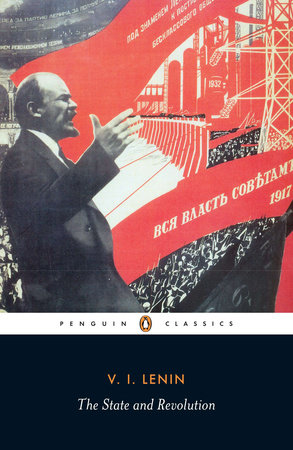
The State and Revolution by Vladimir Ilich Lenin
Edition shown: Penguin Classics / translated, edited and introduced by Robert Service / paperback / ISBN 9780140184358
Place in the sequence: Marxism transformed into a theory of revolutionary state power
Lenin appears only after Marx because The State and Revolution is most illuminating when read as an intervention inside Marxism, not as a transparent summary of Marx. Written in 1917 amid revolutionary crisis, the book reconstructs arguments from Marx and Engels about the state, the Paris Commune, class rule and the transition toward communism. Lenin’s central claim is that socialist politics cannot simply inherit the existing bourgeois state machinery and administer it for different purposes.
That claim raises questions the earlier books leave open. If economic domination is embedded in social structures, what political form can transform them? Is the state a neutral instrument, a condensation of class relations, or an institutional structure whose inherited forms constrain what governments can do? What is meant by the “dictatorship of the proletariat,” and how does Lenin understand the eventual “withering away” of the state?
Read the text historically. Lenin is writing between the collapse of the Russian monarchy and the Bolshevik seizure of power, arguing simultaneously against reformist social democrats, anarchists and rival Marxists. Later Soviet political development cannot simply be read off these pages, but neither should the distance between Lenin’s rhetoric of workers’ power and subsequent state forms be ignored. The historical tension is part of what makes the book indispensable.
Robert Service’s Penguin edition provides an introduction, translation and glossary that help beginners identify Lenin’s interlocutors. Read the book complete: it is short enough that selective reading would remove the argumentative movement from the state as class power to the Commune and the transition beyond capitalism. Then move to Gramsci, whose prison writings ask why revolutionary transformation proved far harder in Western societies than a simple model of state seizure suggested.
Difficulty: Moderate
“As both historical document and political statement, its importance can hardly be exaggerated.”
— Penguin Classics • Penguin Random House

Book 6
Selections from the Prison Notebooks by Antonio Gramsci
Edition shown: International Publishers / edited and translated by Quintin Hoare and Geoffrey Nowell Smith / 1971 / paperback / ISBN 9780717803972
Place in the sequence: Hegemony, civil society, culture and the Western Marxist problem
Gramsci is the right culmination because he exposes the limits of a beginner’s picture of Marxism formed only from economics and state power. Writing in fascist prison between 1929 and 1935, he asks why capitalist societies can remain politically durable even amid conflict and crisis. The answer cannot be reduced to police, law or direct coercion. Ruling groups also exercise leadership by helping organize the institutions, habits, languages and forms of common sense through which social arrangements acquire legitimacy.
This is the terrain of hegemony. Schools, churches, newspapers, intellectual life, associations and civil society become politically consequential because domination is stabilized partly through consent. The concept is often weakened into a synonym for cultural influence. Gramsci means something more demanding: a social group becomes politically effective when it can present its particular project as capable of organizing broader interests, alliances and conceptions of the world.
The edition itself requires caution. Gramsci did not arrange his prison notes as a finished systematic book. Hoare and Nowell Smith grouped selections thematically, making English-language study vastly more practical while also creating an editorial architecture the notebooks themselves did not possess. The Antonio Gramsci Internet Archive’s contents page explicitly warns readers about this editorial reorganization.
For a first pass, read the sections on intellectuals, the modern prince, state and civil society, Americanism and Fordism, and the philosophy of praxis. Do not attempt to force every note into one theory. Gramsci’s fragmentary form is part of the difficulty, as are censorship and the coded vocabulary of the prison writings. Readers wanting further orientation should use BookInLight’s guide to Gramsci and cultural hegemony after, not instead of, engaging the primary selections.
Difficulty: Advanced
“Hoare and Smith organized these notes around particular topics”
— Antonio Gramsci Internet Archive • Marxists Internet Archive
How these books fit together
The sequence has three major movements. Books 1–3 establish Marx before Marxism becomes a twentieth-century political tradition. Singer supplies the map; the Manifesto gives the reader a direct encounter with revolutionary argument; McLellan then prevents that pamphlet from standing in for four decades of changing philosophical, political and economic work.
Book 4 changes the level of analysis. Capital asks how capitalist social relations reproduce themselves through apparently ordinary transactions among legally free commodity owners. The focus on value, labor-power, production and accumulation is more precise than the dramatic historical compression of the Manifesto. It is also the point at which later disputes over what Marx “really” discovered become unavoidable.
Books 5–6 show Marxism becoming a tradition of reconstruction rather than repetition. Lenin addresses revolutionary power, the state and political transition in 1917. Gramsci, reflecting after failed revolutionary expectations in Western Europe and under fascism, shifts attention toward civil society, political leadership, intellectuals and consent. The conceptual movement from commodity to state to hegemony explains why Marxism became influential far beyond economics.
This path is intentionally incomplete. It leaves Rosa Luxemburg, Lukács, Trotsky, Mao, the Frankfurt School, Althusser, Marxist feminism, anti-colonial Marxism, analytical Marxism, social-reproduction theory and ecological Marxism for later specialization. A beginner gains more by understanding six arguments properly than by recognizing thirty names without knowing what changed between them.
Common beginner mistakes
Beginning with Capital because it is Marx’s masterpiece. The book is indispensable, but starting there often turns conceptual difficulty into dependence on summaries. A short orientation and several representative primary writings make the architecture visible without diluting the argument.
Treating the Manifesto as the complete doctrine of Marxism. Its rhetoric is unforgettable, but it belongs to 1848, a particular organization and a revolutionary conjuncture. Mature Marxian political economy cannot be reconstructed from its compressed claims.
Assuming Marx, Lenin, Stalin and Gramsci say essentially the same thing. The historical tradition contains continuities, but it is structured by disagreement. Lenin reconstructs Marx on the state; Gramsci rethinks political strategy under different institutional conditions. Later political regimes add another level that must be studied historically rather than collapsed into an authorial chain.
Reading every concept as an economic reduction. Marxist analysis certainly assigns major explanatory importance to production and class, but serious Marxist traditions have debated law, politics, nationalism, race, gender, empire, culture, ideology and ecology precisely because the relationship between economic structure and other forms of power is not self-explanatory.
Trying to decide whether Marxism is “right” before deciding which claim is under examination. Predictions about revolution, the labor theory of value, alienation, class analysis, historical materialism, state theory and communist political strategy require different evidence. Intellectual seriousness begins by disaggregating them.
Optional paths depending on your interest
If you are interested in political economy, prioritize Capital, Volume 1. Afterward, continue to Volumes II and III and compare contemporary companions rather than assuming Volume I contains Marx’s complete theory of capitalism.
If you are interested in revolution and political power, prioritize The State and Revolution. Follow it with Marx’s writings on the Paris Commune and then compare Lenin with Rosa Luxemburg and later debates about party organization and democracy.
If you are interested in ideology, media, education and culture, prioritize Gramsci’s Selections from the Prison Notebooks. His account of hegemony is a better foundation than beginning with later cultural-studies summaries that detach the concept from socialist strategy.
For a more advanced path, continue with Moishe Postone’s Time, Labor, and Social Domination. Postone reconstructs Marx’s critique around value, abstract labor and historically specific forms of social domination, making it especially productive after a complete first reading of Capital.
FAQ
Do I need to read Hegel before following this Marxism for Beginners path?
No. Learn the basic ideas of contradiction, mediation, alienation and dialectical development from a reliable secondary source, then return to Hegel when a specific Marxian argument requires it. Reading the entire Phenomenology or Science of Logic first is unnecessary preparation for most beginners.
Should I use the Reitter or Fowkes translation of Capital?
Reitter’s 2024 Princeton translation is an excellent first reading edition and foregrounds the second German edition Marx personally revised. Fowkes remains important because decades of English-language scholarship use its vocabulary and pagination. Serious long-term study benefits from access to both.
Do I have to read every page of the selected writings and prison notebooks?
No. McLellan’s Marx reader is designed for selective use after several central texts have established the trajectory. Gramsci’s prison selections are also better approached thematically on a first pass. Complete reading becomes more useful once specific research questions have emerged.
How is this path different from a university course on Marxism?
A university syllabus normally includes more historical context, secondary scholarship, rival socialist traditions, criticism of Marxism and specialized themes such as imperialism, race, feminism or ecology. This sequence is narrower: it establishes the conceptual spine needed to enter those debates intelligently.
Related BookInLight Reading Guides
Before the Commodity: A Reader’s Route into Marx’s Capital, Volume I — A focused preparation guide for commodities, value, labor-power, surplus value and the historical background required before tackling Marx’s major economic work.
Seven Essential Books on Gramsci and Cultural Hegemony — The natural continuation for readers interested in civil society, intellectuals, consent, political strategy and Gramsci’s later interpreters.
Learning to Think Politically: Nine Books for a Serious Beginner — Places Marx and Engels within a broader sequence of political philosophy, alongside arguments about authority, rights, liberty, democracy and justice.
This article was researched and written by the BookInLight Department of Social Theory and the History of Ideas. It underwent bibliographical review, source verification, quotation verification, link verification, and editorial fact-checking. Readers are invited to submit factual corrections, overlooked sources, edition suggestions, interpretive observations, and other constructive ideas that may strengthen future revisions.
The BookInLight Art Department is credited for editorial art direction, visual composition, cover selection, and image presentation. Rights in third-party book covers remain with their respective publishers, artists, designers, and other rights holders. Complete republication, reproduction, translation, or reuse of this article, whether in print or digital form, requires prior written authorization from BookInLight.
Sources and Further Reading
Primary Texts and Editions
Peter Singer. Marx: A Very Short Introduction, second edition. Oxford University Press, 2018. Oxford Academic. Edition, contents, publication data, and interpretive orientation.
Karl Marx and Friedrich Engels. The Communist Manifesto. Samuel Moore translation; introduction and notes by Gareth Stedman Jones. Penguin Classics, 2004. Penguin Books. Exact edition and historical apparatus.
Karl Marx. Karl Marx: Selected Writings, edited by David McLellan, second edition. Oxford University Press, 2000. Google Books. Bibliographical confirmation and scope.
Karl Marx. Capital: Critique of Political Economy, Volume 1. Translated by Paul Reitter; edited by Paul Reitter and Paul North. Princeton University Press, 2024. Open Library. Exact ISBN and edition record.
Vladimir Ilich Lenin. The State and Revolution. Translated and edited by Robert Service. Penguin Classics. Penguin Books. Edition, translation, and historical description.
Antonio Gramsci. Selections from the Prison Notebooks. Edited and translated by Quintin Hoare and Geoffrey Nowell Smith. International Publishers, 1971. Open Library. Exact edition record and identifiers.
Scholarly Studies and Reference Works
Jonathan Wolff. “Karl Marx.” Stanford Encyclopedia of Philosophy. Biographical, philosophical, political, and economic framing.
Ulrich Plass. “More Marx, Less Marxism? Reconsidering Capital, Volume 1, Retranslated by Paul Reitter.” Modern Intellectual History, 2025. Translation history and textual interpretation.
Humanities and Social Sciences Communications. “The hedgehog, fox, and quasi-hedgehog approaches in Isaiah Berlin’s, David McLellan’s, and G. Stedman Jones’ Marx research.” Nature Portfolio. McLellan’s role in English-language Marx scholarship.
Antonio Gramsci Internet Archive. “Selections from the Prison Notebooks.” Marxists Internet Archive. Contents and warning concerning the thematic organization of the English selections.
George T. Potter Library. Catalogue record for Selections from the Prison Notebooks of Antonio Gramsci. Library catalogue. 1971 International Publishers bibliographical verification.
UK Parliament. “The 1833 Factory Act.” UK Parliament. Industrial legislation and context for Marx’s working-day analysis.
BookInLight. “Before the Commodity: A Reader’s Route into Marx’s Capital, Volume I.” BookInLight. Conceptual prerequisites, translation comparison, and reading dependencies.
BookInLight. “Seven Essential Books on Gramsci and Cultural Hegemony.” BookInLight. Gramsci’s reception, hegemony, and advanced reading path.
BookInLight. “Learning to Think Politically: Nine Books for a Serious Beginner.” BookInLight. Placement of Marx and Engels within modern political philosophy.
Terry Eagleton. Why Marx Was Right, second edition. Yale University Press, 2018. Yale University Press. Accessible discussion of recurrent objections to Marx and Marxism.
Image Credits
Marx: A Very Short Introduction — Oxford University Press, second edition, 2018, paperback, ISBN 9780198821076. Cover delivered through the Open Library ISBN cover service; edition correspondence checked against the Oxford Academic edition page.
The Communist Manifesto — Penguin Classics, Samuel Moore translation with Gareth Stedman Jones introduction and notes, 2004 paperback, ISBN 9780140447576. Cover delivered through Penguin Random House’s cover server; correspondence checked against the Penguin edition page.
Karl Marx: Selected Writings — Oxford University Press, David McLellan, second edition, 2000 paperback, ISBN 9780198782650. Cover delivered through the Open Library ISBN cover service; edition details checked against the Google Books edition record.
Capital: Critique of Political Economy, Volume 1 — Princeton University Press, Paul Reitter translation, 2024 hardcover, ISBN 9780691190075. Cover image hosted on Wikimedia Commons; exact edition correspondence checked against the Open Library edition record.
The State and Revolution — Penguin Classics, translated and edited by Robert Service, paperback, ISBN 9780140184358. Cover delivered through Penguin Random House’s official image server; correspondence checked against the Penguin edition page.
Selections from the Prison Notebooks — International Publishers, edited and translated by Quintin Hoare and Geoffrey Nowell Smith, 1971 paperback, ISBN 9780717803972. Cover delivered through the Open Library ISBN cover service; bibliographical correspondence checked against the Open Library edition record.
Image credit: Vasily Perov — Source: Wikimedia Commons — License: Public Domain